Tuesday, March 31, 2009
More Skills USA
Here is a list of the contests that are a part of the Nebraska Skills USA Competition:
3-D Visualization
Advertising and Design
Architectural Drafting
Architectural BluePrint Reading
Automated Manufacturing Technology
Automotive Parts
Automotive Service Technology
Automotive Refinishing
Basic Health Care Skills
CNC Turning and Mill
Cabinetmaking
Carpentry
Collision Repair Technology
Commercial Baking
Commercial Photography
Computer Maintenance
Cosmetology
Criminal Justice
Culinary Arts
Customer Service
Diesel Equipment Technology
Crime Scene Investigation
Electronics Applications
Electronics Technology
Firefighting
First Aid/CPR
Food and Beverage Service
Internetworking
Industrial Motor Control
Job Skill Demonstrations
Mechatronics
Medical Assisting
Metric 500
Motorcycle Service Technology
Nurse Assisting
Photography
Plumbing
Power Equipment Technology
Precision Machining Technology
Pre-School Teaching Assistant
Related Technical Math
Residential Wiring
Sheetmetal
Structural Steel
TeamWorks
Technical Computer Applications
Technical Drafting
Television (Video) Production
GMAW Welding
GTAW Welding
SMAW Welding
Welding Post Secondary
Oxy-Acetylene Welding
Welding Fabrication
Web Design
The Champions from Nebraska's competition will go on to Nationals. They will be offered scholarships and job opportunities. Right out of high school or with a two-year degree, these talented young people can take up a career that is productive and rewarding.
According to the instructor I spoke to, graduates of the two-year electrical program at Mid-Plains Community College can command wages of up to $80,000.00 per year. And that is without the crippling student loan debt that it takes to go to a four-year college.
Now don't get me wrong. I see the need for both white collar and blue collar jobs. Both four-year colleges and two-year colleges and technical schools have their merits.
I just know who I am going to call when my furnace isn't heating during a cold Nebraska winter (or spring, as the case may be). I can only hope that there is someone out there who can do the job.
Something to think about.
Thanks for stopping by. The coffee is always on.
Monday, March 30, 2009
The North Platte Canteen
I am going to cheat once again with my blog post. They say a picture is worth a thousand words, so a seven minute video must be worth a couple pages of text.
The North Platte Canteen is one of the most heartwarming stories to come out of the homefront of World War II. At that time, North Platte was a sleepy little western Nebraska town of about 12,000. Little did the volunteers who started the North Platte Canteen in the Union Pacific Depot on Christmas Day 1941 know that it would take more than 55,000 volunteers to keep the Canteen open for 54 months during the war. The Canteen closed it's doors on April 1, 1946 after serving more than 6.5 million (yes, that's six and a half million) service men and women.
But, the video tells it much better than I can.
Thank you for stopping by. Now you know why the tradition of serving coffee is alive and well.
Sunday, March 29, 2009
Little Hands
Her lyrics touched the heart of everyone here, and I'm sure we all have our favorite. But I would like to share with you a part of the song that really struck me last night:
...And I'm just wondering about the little things
And what they all add up to mean
The sum of which I may never understand
We've all got big plans
And little hands
...We do the best we can
With little hands
One of the wonderful things about song lyrics is that each person can read into them the particular message that touches them. What this song means to me, is that we all need to do our part, no matter how small a part that is.
Whether it's turning off your lights for an hour during Earth Hour (which we forgot to do last night), recycling, volunteering in your community, or just being kind to someone, it all adds up and makes a difference.
Thank you for stopping by. I'm serving coffee, but the caffeine hasn't kicked in yet!
Saturday, March 28, 2009
SkillsUSA
SkillsUSA is a career serving student organization (CSO) serving high school and college students enrolled in programs preparing them for technical, skilled and service careers. Students embrace our slogan "SkillsUSA: Champions at Work" by learning leadership, teamwork, citizenship and character development - traits that go into shaping responsible, reliable employees who will one day become leaders in the workplace.
SkillsUSA is dedicated to building champions for America's work force and emphasizes high ethical standards, superior work skills, lifelong education and pride. SkillsUSA also promotes community service, patriotism and an understanding of the free enterprise system.
SkillsUSA Nebraska has yearly state competitions that allow students to showcase their skills and an opportunity to advance to national competitions.
You can find more information at www.SkillsUSANebraska.org.
This is also the perfect time to mention the important work being done in this area by Mike Rowe. You may all know Mike Rowe as just the host of "Dirty Jobs" on the Discovery Channel. But he also plays another role as the champion of the skilled trades in America. You can find that part of his work at www.mikeroweworks.com.
Here is a quote from Mike's open letter to President Barak Obama shortly after his inauguration.
Forty years ago, people understood that sweat and dirt were the hallmarks of important work. Today, that understanding has faded. Somewhere in our economy’s massive transition from manufacturing to financial services, we have forsaken skilled labor, along with many aspects of our traditional work ethic. Trade school enrollments are down, even as our infrastructure crumbles around us. I don't think that's a coincidence. Community Colleges are routinely described as alternatives to a “proper” education. Madison Avenue bombards us with messages that equate happiness with leisure. Hollywood portrayals of hard work usually embody an element of drudgery or some silly stereotype, and jobs once considered vital to our society are now simply overlooked. The ranks of welders, carpenters, pipe fitters, and plumbers have been declining for years, and now, we face the bizarre reality of rising unemployment, and a shortage of skilled labor. Strange days.
Whether through elitism or indifference, the net result is the same – people have slowly shied away from these jobs. Not because they aren’t important or lucrative – but because they are simply not celebrated. This perception is real Mr. President, and I believe it’s standing squarely in the way of your recovery plan, as well as your initiative for Volunteerism and national service. In my opinion, it needs to be corrected as soon as possible, which brings me back to my idea.
mikeroweWORKS.com is a destination for anyone looking to investigate a career in the Skilled Trades. Its purpose is to encourage, educate, and celebrate the business of Work, by focusing on those opportunities related to rebuilding our national infrastructure. The idea grew from the mission of Dirty Jobs, and evolved with the help of loyal viewers who constantly provide the site with daily links to scholarships, apprenticeships, fellowships, and other worthwhile programs. Large corporations have offered support. Industry leaders, Retired Generals, teachers, laborers, professors, parents, and students have all gotten involved. My hope for mikeroweWORKS is that it function not just as a useful resource, but also as a “call to arms,” and ultimately, a PR Campaign for Skilled Labor. I would like to see mikeroweWORKS help assure that those three or four million jobs you wish to create, are jobs that people feel proud to have.
People often tell me that Dirty Jobs reminds them of a time when Work was not seen as a thing to avoid. When skilled tradesmen were seen as role models, and a paycheck was not the only benefit of a job well done. We need to recapture that sentiment. We need to celebrate, on a bigger scale, the role models right in front of us. Dirty Jobs has given me the opportunity to do that. With a little luck and the right support, mikeroweWORKS, will take it to the next level.
Many of the comments from the instructors and advisors I met at SkillsUSA echoed these views.
Something to start thinking about.
Thanks for stopping by. The coffee will be served during tonight's House Concert (shameless self-promotion!). I hope to see you all here.
Friday, March 27, 2009
Right Here in Nebraska
Sometimes blogging can be hard work. It's not that there isn't enough to write about, or that I don't like writing, it's just finding the time to do it.
Other times, it's easy. Thanks to this gift from my friend in Grand Island, my post for the day is ready-made.
Enjoy
Thanks for stopping by. The coffee is always on, and there's Diet Coke in the fridge.
Thursday, March 26, 2009
Personal Resolutions
As many of you who know me no doubt already know, I am embarrassingly, paralyzingly, deathly afraid of storms. Thunder, lightning, rain, wind, tornados... Anyone who has ever witnessed a meltdown during the height of a storm will understand. I lose all ability to think rationally after the first clap of thunder.
Here's a quote from the National Weather Service website from Tuesday:
Which brings me to my resolution: To be BRAVE! I haven't quite figured out how to do it yet. My heart was pounding just looking at the clouds on the way in to work on Monday, and seeing the rainbow colored weather map indicating all the watches and warnings, but now that I've written it, I am committed to it. I will stop being a coward and learn to enjoy our wild Nebraska weather...Wild weather ensued across western and north central Nebraska on Monday, March
23rd, with severe thunderstorms that produced isolated tornadoes, some large
hail and damaging winds. In addition to the severe weather, a cold front
and associated strong upper level system brought strong gradient wind gusts that
created blizzard conditions as heavy snow fell resulting in closed roads across
parts of Sheridan County. Early reports indicated snow accumulations of 6 to 8
inches near Rushville, with snow drifts up to 4 feet observed 5 miles north of
Rushville. To add to the wild weather the first tornadoes of the season
occurred. A brief tornado touched down 9 miles south of Brownlee in Cherry
County, where the tornado damaged a lean-to on a barn. Then another tornado
touched down 7 to 8 miles north of O'Neill, where early reports indicated some
downed power lines and a few grain trailers tipped over. Below are images taken
from Google Earth Professional that show storm reports across western and north
central Nebraska on Monday.
Thanks for stopping by. If it's storming, the coffee will be served in the basement to the accompaniment of the weather radio.
Wednesday, March 25, 2009
Crazy Days
Tuesday, March 24, 2009
Cajun Karl and Acadian History and Culture
Karl Breaux is a French speaking CAJUN, born in Lafayette, Louisiana and has received awards from the governments of France and Louisiana for his efforts to protect the French language. Karl's commitment to the culture of the legally recognized "Acadiana" region of French Louisiana is evident in his efforts to highlight the various historic and eco-cultural destinations.
Karl works with his family in their supermarket and has cooked for many years at hunting camps, family outings and public events. Karl has a unique way of enjoying Louisiana’s Paradise while showing how a real and True CAJUN cooks the traditional meals as well as the modern methods of preparing Great Home Cooked Meals. Karl's authentic product line finally gives everyone a chance to experience a family style Cajun meal, just like someones' grandma cooked it here in South Louisiana.
To quote Karl’s favorite saying:
“Love everyone and have fun, it is a short life”
The 700,000 Cajuns who live in South Louisiana are descendants of French Canadians. About 18,000 French-speaking Catholic inhabitants from Brittany, Poitou, Normandy, and across France established the French colony of Acadia, now Nova Scotia, Canada. The year was 1604 - sixteen years before the Mayflower landed at Plymouth Rock, thus establishing one of the first permanent colonies on the North American continent. By the time the British won the colony from France in 1713, they had established a thriving, self-sufficient community.For refusing to pledge allegiance to the British crown, which required renouncing their traditional Catholic religion for that of the Anglican Church, they were forced from their homes in 1755. This cruel and tragic event, known as Le Grand Derangement, separated families and forced people to flee with only the possessions they c ould carry. Homes and crops were burned by the British and the Acadians went to sea under dreadful conditions. More than half lost their lives.The survivors were scattered along the U.S. eastern seaboard and France until 1784, the King of Spain consented to allow them to settle in South Louisiana. Most followed the path which led to New Orleans. There they received a hostile greeting from the French aristocracy so they headed west of the city into unsettled territory. They settled along the bayous of south central and south western Louisiana where they could live according to their own beliefs and customs.For several generations, the Cajuns raised various crops and lived on the bayou where they fished and trapped. Today, Cajuns are famous for their unique French dialect, their music, their spicy cooking and for their ability to live life to its fullest.
Monday, March 23, 2009
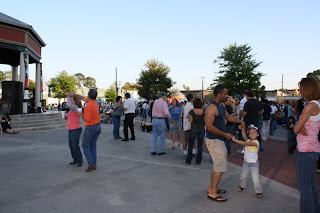
Downtown Alive
A long but very fun day. A bit more tomorrow, then I think I'll be done with Louisiana.
Thanks for stopping by. The coffee is always on.
Sunday, March 22, 2009
A Nebraskan in Louisiana
Just to reassure everyone that there is a little bit of work being done, here are pictures from the trade show floor where all of Nebraska’s representatives are busy selling the Bank Club Directors on the virtues of our various destinations.
There’s Grand Island

South Sioux City

And the Omaha Henry Doorly zoo

And of course, North Platte.

I have to tell you that there are several things that stand out about the Cajun culture. The first is food, and the second is music. Not necessarily in that order. There is also the warm friendliness of the people, the outstanding climate (at least while we’ve been here), and the beautiful scenery and wildlife. If I had a recorder, I would post the lively bird songs that can be heard all of the time. Of course, the hotel staff described them as “annoying”, so it must be something that you get used to after awhile.
After that it was off to our local tours. I was fortunate enough to be on the one called “Cajun for a day”, which included lunch at McGee’s Landing.

I chose the Shrimp Etouffee,
and was lucky enough that someone at my table also ordered the fried catfish, which they shared. It was all delicious.
After that came a boat tour of the Atchafalaya Swamp. It is an absolutely incredible place. It is approximately 20 miles in width and 150 miles long, making it the largest swamp in the United States. As you can imagine, we only got to see a small portion of it.

It is home to the bald cypress tree, which is now protected after all of the old-growth timber was logged out some time in the mid-part of the 20th Century. The trees in the pictures are about 80 years old, and the ones they logged out were more than 200 years old.

The moss you see hanging from the trees isn’t a parasite like mistletoe, but a plant that gathers all of it’s nutrients from the air. The Ford motor company used the moss as stuffing for the cushions of his vehicles, up until about the 1950’s. They specified that the moss be shipped in cypress crates, and the lumber was also used in the manufacturing process.

At this point it would be good to tell you that our wonderful guide Curtis was a native French-speaking Cajun, and admitted that the Cajuns enjoy a fondness for telling a good story. So I am only repeating what we were told. I don’t vouch for it’s truthfulness.

I mentioned the crawfish boil we enjoyed. I learned that: Louisiana leads the nation, producing more than 90% of the domestic crop. More than 1,600 farmers produce crawfish in some 111,000 acres of ponds. More than 800 commercial fisherman harvest crawfish from natural wetlands, primarily the Atchafalaya Basin. The combined annual yield ranges from 75 million to 105 million pounds. The total economic impact on the Louisiana economy exceeds $120 million annually, and more than 7,000 people depend directly or indirectly on the crawfish industry. I have vowed to eat more crawfish to support the industry. Not much of a sacrifice.
On our swamp tour, we saw lots of wildlife, several different species of birds – egrets, herons, and of course, alligators! Actually, we only saw one alligator, and it slipped under the water before I got the chance to get a picture, but we were told there are LOTS more out there – over a million in the state of Louisiana alone. There are quite a few alligator farms in the area, and they are required to release 18% of their hatch each year. Alligators are hunted only one month out of the year. They are caught on a hook, commonly baited with chicken, then the coup de grace is administered with a firearm.

The swamp is one of the main reasons the Acadians were able to keep their culture intact as the vast wilderness allowed them some measure of isolation from the attempts at modernization.
If you can make it out, there is a tiny shack in the middle of this picture. We were told the Cajun couple who lived there raised 11 children in it.
The I-10 bridge through the swamp is 18.2 miles long and is one of the longest bridges in the U.S. If you look closely at the pillars, you will see that there are high water marks MUCH higher than the water is at the present time.


That’s what I can tell you about the Atchafalaya Swamp from my brief visit. The rest you’ll just have to learn for yourself.
More tomorrow on a few more interesting (to me at least) things about my visit.
Thanks for stopping by. The coffee is always on.
Saturday, March 21, 2009
New Thursday Special from One Foot In The Grave
I like to think about growing up so I’'m going to talk about the toys we played with. I like to hear how you spent your time having fun.
Almost ever Sunday in my life time at home we had a house full of relatives and friends. So we had lot of stuff to entertain our company, and our family. We had a permanent horseshoe court west of our house. Attached to the chicken house were swings and a bar,
Before my time they had a regulation base ball diamond east of the garden and over the hill. We usually had at least two horses to ride and all the saddles and bridles were kept in the barn. The back porch held the croquet to be put up whenever, also a big cupboard where we kept all the hunting guns. The shot put was in the tool shed, bike and stilts were by or in back porch.
Barrel in yard and lot of game to play with a barrel. In the winter we had clamp on ice skate for lot of people. And sleds. Tricycle in the yard.
The wind charger was always good for story to talk about with the city folks who visited. My brothers built a guillotine to chop off chickens heads . We sold that place and moved 7 miles west At the auction we sold all the horse drawn equipment but one plow for the garden and the manure spreader.
At the new home we had a 4 car garage but only owned one car so we kept the tractors, and farm machinery in with the car. It was the back stop for all our baseball games. We moved the shot put (which were really cannon balls), had a wooden bowling ball, horse shoes, bike. In the front yard had a hammock and on east side swing set. The croquet set was kept on the back porch. Ice skates were in the garage. In the winter we played lot of card, checkers, and Chinese checkers. Mom and sister Margaret played piano and we all sang. During track season at both homes Dad would dig a pit for us to practice broad (long) jump.
I wonder what I forgot. I hope some one will tell me. Our family wasn'’t much for sitting around. We didn'’t have fishing stuff because we always went to Uncle Dave and he had all the fishing stuff and a dam where we could fish and catch Bull heads. So much fun. He lived in a canyon by the Niobrara river and we could walk to
A clear conscience is a sign of a bad memory. He who hesitates is probably right.
Joke: Three people were going to the guillotine. The first was a lawyer, who was led to the platform, blindfolded, and he had his head put on the block. The executioner pull the lanyard, but nothing happened. The blade didn'’t come down. To avoid a messy lawsuit, the authorities allowed the lawyer to go free.
The next man to the guillotine was a priest. They put his head on the block but nothing happened. They thought it must have been divine intervention, so they let the priest go.
The third man to the guillotine was an engineer . He waived his right to a blindfold, so they led him to the guillotine and put his head on the block. As he lay there, he said, Hey wait I see your problem.
Friday, March 20, 2009
Traveling to Lafayette Louisiana

Living history interpreters are on hand in many of the homes, barns, shops and business buildings to reenact the early settlers.
Music and dancing is a huge part of the local Cajun culture, and a local dance "crew" entertained us. This particular crew boasts about 150 members, who meet several times a week to dance. They aren't always in costume, but since Mardi Gras wasn't too long in the past, they showed off some of their costumes.
And the Cajun music! Peggy Matt from the Lafayette Convention and Visitors Bureau did a great job lining up entertainment for us. The band was called the Bayou Boys, but when I did a google search to try to give you a link, I came up with a lot of Bayou Boys, so I'm not sure which one they are. I believe the name of the accordion player is Damon Wade. I met his wife and baby boy during the performance.
Cajun music can be joyful and melancholic, reflecting the rich Acadian, Creole and Native American heritage of the area.
Thursday, March 19, 2009
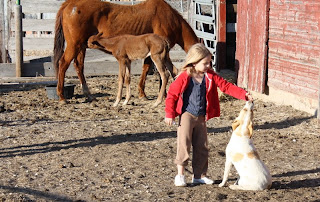
The Family Farm
cats...
chickens...
horses...
goats...
llamas...
and of course, what family farm would be complete without the odd Watusi or two... or four.
I wish I could tell you why my family has Watusi's... but I don't know. But they're quite impressive, don't you think?Wednesday, March 18, 2009
Seifer Farms Pasture Poultry
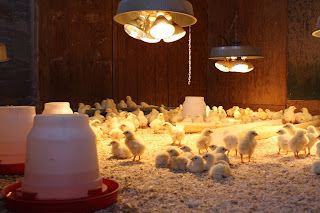
My father passed away in 1993. My mom wanted to become more involved with the farm, but wasn't really in to driving a tractor or working cattle. What she could do is raise chickens. We started that first year raising, butchering and direct marketing about 200 birds, just to get the hang of it. 
Tuesday, March 17, 2009
Happy St. Patrick's Day

The gang at the Espresso Shoppe, plus a lot of extra hands served up hundreds of the delicious meal.
Monday, March 16, 2009
Another Weekend Another Show
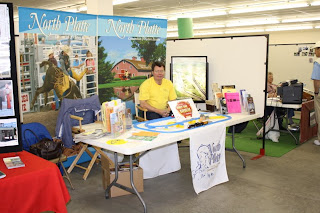
All of the usual suspects were there, the Nebraska Division of Travel and Tourism, the Nebraska Game and Parks Commission, the Valentine Visitor's Bureau, Cornhusker Fishing Camp, Glidden's Canoe Rentals, Western Nebraska, a couple of byways, and a few others that I know I'm missing.
So, while other people were slaving away at the booth, I took a leisurely drive around Lake McConaughy. It got to be around 70 degrees on Sunday, so I enjoyed myself, and appreciated anyone who took the time to come to the show instead of going to the lake themselves.
From the south end of the dam, looking west past Spillway Bay:
Looking into Spillway Bay:
The boat ramp at Martin Bay:
Looking west past Martin bay. It ALMOST has water in it:
From the south end of the dam looking east across Lake Ogallala.
Looking north east from the south end of the dam across Lake Ogallala.
The water interpretive center on the highway south of the dam.
All in all, it was a great day.